Minimalist Cat Toys Clipart Pack
A Designer’s First Look: Clean, Calm, and Quietly Confident
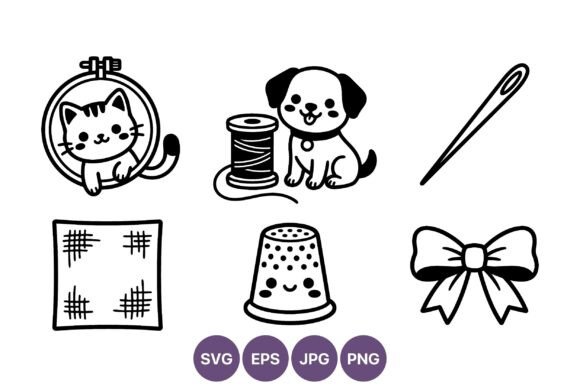
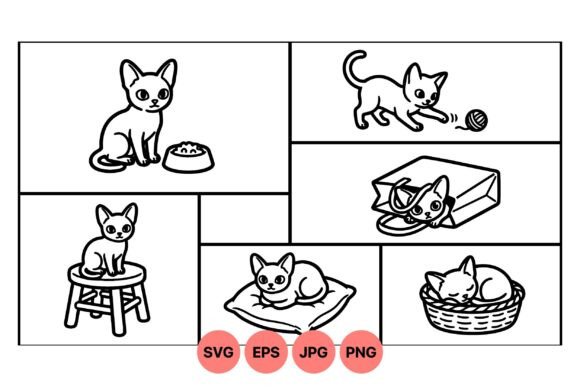
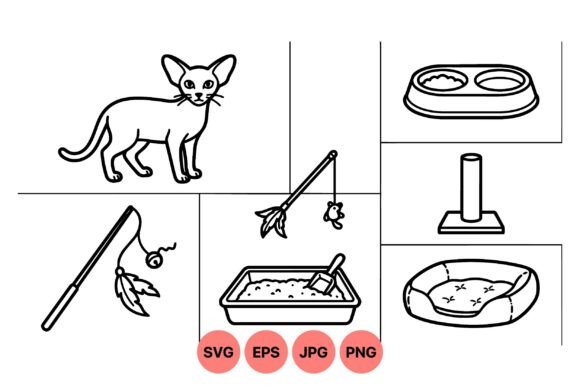
Opening the ZIP folder for the Minimalist Cat Toys Clipart Pack, I felt immediate relief — no cluttered layers, no over-rendered shadows, no forced cuteness. Just a standing kitten drawn in assured, unbroken line work, paired with six pet care icons that breathe space instead of noise. This isn’t “cute overload.” It’s thoughtful visual editing: every curve serves function, every negative space invites stitching clarity. As an embroidery designer who’s stitched everything from toddler onesies to boutique aprons, I knew right away this set would shine on lightweight cotton tees, linen tea towels, and baby-soft knit onesies — but only if treated with intention.
Where It Lives Best: Embroidery Projects That Let Simplicity Speak
I tested the standing kitten motif on a custom embroidered tote bag for a local pet rescue’s fundraiser — natural canvas, medium-weight, lightly textured. With light stabilizer and a 4” hoop, the clean outlines translated beautifully into satin stitch borders and subtle fill stitch bodies. No bleeding, no skipped stitches. The icons (a tiny brush, a bowl, a toy mouse, etc.) scaled cleanly down to 0.75” for a matching patch set — ideal for iron-on appliqué or sewn-on charm accents on denim caps and pillow covers.
For sweatshirt embroidery? Yes — but only on structured, non-stretch fleece with tear-away + cut-away stabilizer combo. The lines hold their shape without distortion, and the lack of fine interior detail means fewer thread breaks during long runs. On baby embroidery projects — think organic cotton burp cloths or muslin swaddle tags — the design reads clearly even at 1.25”, and parents consistently comment on how “gentle” and “uncluttered” it feels compared to busier cat motifs.
Where Caution Is Key: Real Fabric & Stitching Boundaries
This isn’t a one-size-fits-all machine embroidery design. On thin fabrics like voile or rayon challis? Skip the fill stitch entirely — stick to running stitch outlines or delicate satin borders. On dark fabric, test thread color contrast first: light gray or oatmeal thread reads softly but may vanish on charcoal; off-white or heathered ecru pops with warmth and craft authenticity. Curved surfaces like baseball caps demand simplified versions — I’d drop two of the smaller icons and center just the kitten + one key symbol (e.g., the toy mouse) to avoid distortion near the bill seam.
Layered garments — think reversible zip hoodies or quilted jackets — need extra stabilizer depth and lower stitch density to prevent puckering. And while the line art adapts well to printable mockups and digital product previews, remember: what looks crisp on screen won’t always translate to dense fill stitch on terry cloth towels. Always run a test on scrap fabric *with your exact thread, needle, and stabilizer stack* before committing to a client order or Etsy batch.
What It Adds to Your Handmade Product — Beyond Aesthetics
The Minimalist Cat Toys Clipart Pack quietly elevates perceived value. Because it’s not shouting, it invites attention — customers pause, lean in, notice the quiet confidence in the kitten’s posture, the intentional spacing between icons. That translates directly to higher engagement on Etsy listings and stronger brand consistency for small shop owners building a calm, considered aesthetic (think: slow-living pet brands, mindful baby boutiques, or Scandinavian-inspired kitchen goods).
It also builds trust. When a customer orders a personalized gift — say, a linen pillow cover with their cat’s name stitched beneath the minimalist kitten — the clean graphic doesn’t compete with the lettering. It supports it. There’s no visual fatigue, no “too much.” That professionalism matters, especially for wedding gifts (custom pet-themed napkins), holiday embroidery (embroidered ornaments with tiny icons), or nursery decor where softness and simplicity are non-negotiable.
Designer Notes You’ll Actually Use
- Always test on scrap fabric first — especially with textured weaves or stretchy knits.
- Check thread color contrast on both light and dark backgrounds using physical swatches, not just screen previews.
- Review stitch density before scaling down — tight fills can collapse below 1.5”; consider switching to outline-only mode for under-1” applications.
- Confirm hoop size compatibility — the full layout fits comfortably in a 5×7”, but tighter compositions (like single icons) work in 3×3” hoops for patches and baby items.
- Inspect small details at actual stitch size: those delicate paw lines? They hold up well at 2x scale but blur if shrunk beyond 0.6”.
- Test black-and-white mockups — this design relies on shape and rhythm, not shading, so monochrome previews reveal true legibility.
- Use proper stabilizer: medium-weight cut-away for knits, tear-away for stable wovens, and fusible + tear-away for lightweight linens.
- Verify licensing before selling finished products or bundling as part of a digital embroidery file collection — the pack is listed as Graphics under Illustrations, but commercial use terms must be confirmed directly with the creator.
Final Thought: Not Just Clipart — A Design Decision
The Minimalist Cat Toys Clipart Pack isn’t about filling space. It’s about choosing clarity over complication, calm over chaos. It works because it respects the craft: the hand behind the hoop, the eye of the customer, the quiet dignity of a cat just standing there — present, unhurried, perfectly drawn. Whether you’re an Etsy seller launching a new line of embroidered pet bandanas, a craft business owner designing holiday kitchen towels, or a hobbyist stitching a one-of-a-kind baby gift, this set gives you room to breathe, stitch with confidence, and let the handmade quality shine — not the graphics.